🎉 Congratulations on a Successful Thesis Defense!
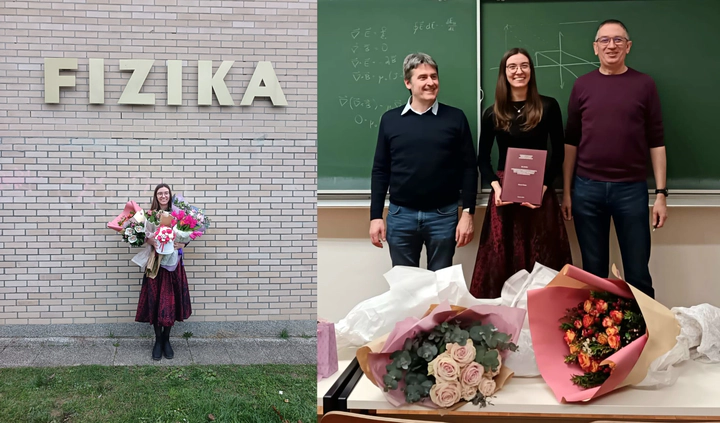 Graduation ceremony at University of Zagreb with Roberto and Prof. Davor Horvatić (Image credit: Eva)
Congratulations to our Master’s student, Eva Hudec, on successfully defending her thesis. It has been a great pleasure to work with her and to accompany her throughout this important milestone. We sincerely appreciate her dedication, enthusiasm, and contributions, and we wish her all the best and much success in her future endeavors.
Connecting Microscopic Dynamics, Structural Rearrangements and Rheological Properties in Soft Materials
Abstract
When subjected to mechanical loading, yield-stress materials exhibit complex deformation behaviors that are exploited in numerous scientific and industrial applications. Yet, the microscopic mechanisms governing yielding remain incompletely understood. In particular, it is unclear whether the onset of microscopic irreversibility coincides with conventional macroscopic yield criteria.
This thesis focuses on the relationship between microscopic dynamics and macroscopic rheological response in two Carbopol microgel systems using phase-synchronized echo rheo-microscopy. Tracer particle displacements are analyzed using tail-sensitive statistical methods, including distribution model selection via the Anderson–Darling statistic and Hill-exponent estimation, enabling the detection of rare, intermittent rearrangements that are obscured by ensemble-averaged observables.
Although the two systems exhibit similar macroscopic rheological signatures, they display qualitatively distinct microscopic yielding pathways. PG Carbopol shows an abrupt onset of intermittent rearrangements near the macroscopic crossover point (G’ = G"), whereas AQ Carbopol undergoes a gradual transition at strain amplitudes well above this crossover. Ensemble-averaged measures such as the mean-squared displacement are insensitive to these differences, whereas tail-sensitive descriptors reveal clear dynamical regime transitions.
These findings demonstrate that microscopic and macroscopic yielding criteria do not generally coincide and support a regime-based description of yielding in soft microgel systems. More broadly, the work establishes echo rheo-microscopy combined with tail-sensitive statistical analysis as a quantitative framework for linking nonlinear rheological response to microscopic structural dynamics.
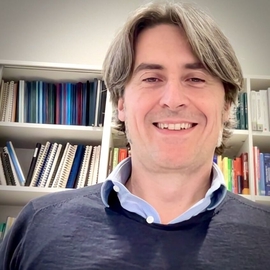
Roberto Cerbino
Professor of Experimental Soft Matter Physics
My research interests include Soft matter physics, living matter, cell biophysics and quantitative microscopy.